Before the Policy Cycle: How the Stages Became a Teaching Model
The policy cycle makes public decisions easier to discuss by separating recurring tasks, while showing why real policy work rarely follows a tidy loop.
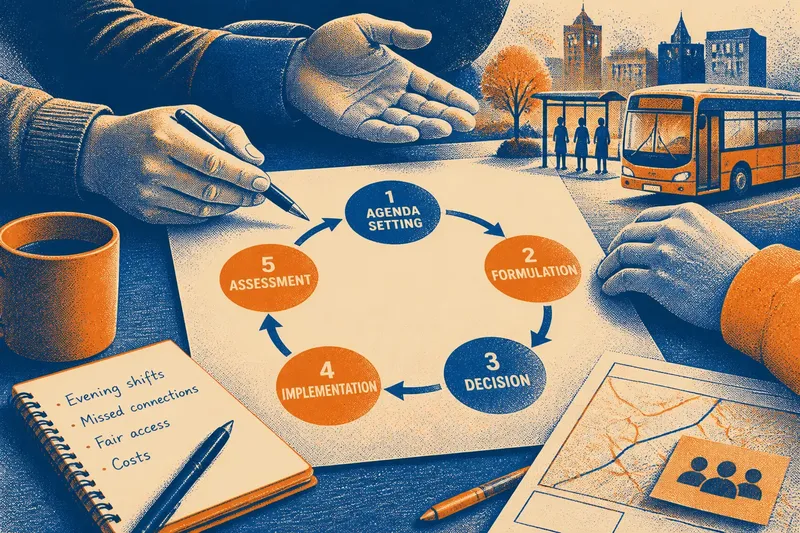
At a town library, a parent asks why the council is discussing late-evening bus services when the timetable was reviewed only recently. A neighbour says the issue must be “back at the beginning”. The exchange exposes a useful puzzle: public policy often appears to move through recognisable stages, but the people involved do not necessarily move through them in order. The policy cycle is a way to make those activities legible, not a map of every decision’s actual journey.
In policy teaching, a cycle usually names a set of recurring tasks: an issue is recognised, options are developed, a decision is made, a policy is put into practice, and its effects are assessed. The labels vary across textbooks and courses. Their purpose is similar: to give learners a handle on a complicated process and a common language for asking what happened, who acted and what remains unresolved.
A teaching model, not a timetable
The cycle is often drawn as a ring, with arrows joining stages. That image can suggest a smooth sequence: one phase ends, the next begins, and assessment sends the work back to the start. It is an attractive classroom picture because it offers a clear route through a subject that otherwise involves many institutions, arguments and overlapping decisions.
Yet the diagram should be read as a sorting device rather than a timetable. “Agenda-setting”, for example, describes how some concerns attract sustained public and official attention while others do not. “Formulation” refers to the work of shaping possible responses. Neither label tells us that a concern must be fully settled before options are considered, or that the same people control each activity.
Teaching models simplify on purpose. A street map leaves out the texture of every pavement but helps a reader locate a destination. Similarly, a policy-cycle diagram can help a class distinguish a decision from its delivery, or an announced aim from later scrutiny. The simplification becomes a problem only when the drawing is mistaken for a complete description of political life.
How the cycle took shape
The policy cycle belongs to a broader effort to study public policy by dividing a sprawling subject into activities that can be examined. In policy analysis and teaching, stage models offered a practical alternative to treating government as one undifferentiated act. They encouraged learners to ask not only what a policy says, but how an issue reaches decision-makers, how a response is organised and how consequences are considered.
There is no single universally fixed cycle. Some accounts use a compact sequence; others split out consultation, adoption, implementation or evaluation as separate stages. The differences matter less than the shared teaching move: take a complex process and identify questions that can be asked at different points.
This approach also made comparison easier in a classroom. Students could examine different policies using a shared set of prompts without claiming that every policy had the same history. A model might direct attention to the choice of options in one case and to delivery arrangements in another. Its value lies in the questions it makes available, not in predicting what officials will do next.
One issue, several routes
Say a fictional town receives repeated complaints that the final buses leave before some evening-shift workers can reach home. The council’s transport committee places the issue on its discussion list. In a neat cycle, this could be described as agenda-setting: a concern has become visible enough to receive official attention.
Staff then prepare possible responses. They might consider adjusting a timetable, coordinating with a neighbouring authority or asking the transport operator to explain existing constraints. This is formulation. But the work need not wait for the concern to stop changing. At a public meeting, workers may describe missed connections; the operator may point to a separate service agreement; councillors may ask for a clearer account of who would be affected by each option.
The committee chooses to request a revised proposal rather than settle the matter immediately. In a teaching diagram, the discussion may look like a move from formulation back towards agenda-setting, because the issue has been reframed. In practice, it is simply one meeting in which new information alters what people think needs attention. The cycle gives a name to the overlapping work; it does not make the overlap disappear.
Later, the council agrees to ask the operator to trial a revised departure time, subject to the relevant service arrangements. That is a decision, but it is not yet the service itself. The operator must communicate the change, update its timetable and coordinate with any connected services. In the model, these activities belong under implementation. If the change is communicated poorly, a formal decision may not translate into a usable journey.
After the revised timetable has been in place long enough for people to respond, the council asks what happened. Did the change address the concern raised by shift workers? Were there new problems for other passengers? The answers might prompt another adjustment, a different option or a decision to leave the timetable as it is. The teaching cycle can represent this return to deliberation without implying that assessment automatically produces a fresh policy.
Why the loop breaks down
Actual policy work rarely respects clean boundaries. A new event can draw attention to an issue while a response is already being delivered. A funding decision can narrow the options before a formal proposal is complete. Those affected may challenge the way a problem was described, leading officials to reconsider the question while carrying out an existing plan.
Authority is also spread across people and organisations. Elected members may set priorities; civil servants or council staff may develop proposals; service providers may deliver them; and residents may supply information or contest the results. These participants do not necessarily enter in sequence. A diagram with one arrow at a time can obscure their different roles and the points where influence is uneven.
There is another limit: a cycle can make policy appear more settled than it is. A stage label sounds like a box that can be ticked. But deciding whether a problem has been addressed often involves disagreement about whose experience counts, what outcome matters and how much uncertainty is acceptable. Assessment may clarify those disputes rather than close them.
Reading the stages carefully
Used with care, the cycle helps students ask precise questions while keeping the story open to revision. It is most useful when a reader treats each stage as a lens, not a compulsory stop on a conveyor belt.
- Ask what the label means: Does “decision” mean a public announcement, a formal approval or an agreement that still depends on other actors?
- Look for overlap: Were options still being debated while delivery arrangements were being prepared?
- Name the participants: Who had authority, who supplied information and who experienced the effects?
- Notice what changed: Did new events, constraints or public accounts alter the issue or the available responses?
- Separate action from result: A decision to change a service is not the same as that change reaching the people who use it.
- Keep disagreement visible: Different groups may judge the same outcome by different standards.
These prompts prevent a teaching model from becoming a claim that policy is orderly by nature. They also make comparison more thoughtful. Two cases may share stage labels but differ sharply in who set the agenda, which options were considered and how implementation was organised.
Questions about the policy cycle?
Is the policy cycle a theory?
It can be used within broader theories of policy, but the basic cycle is usually best treated as a descriptive framework. It organises questions about recurring activities; by itself, it does not explain why one group gains influence or why a particular option prevails.
Does every policy pass through the same stages?
No. The labels provide a common teaching structure, but policy work can skip, revisit or combine activities. A small administrative change may not attract the same public debate as a contested service decision.
Why use a model that simplifies reality?
Simplification can help learners see distinctions that would otherwise blur together, such as the difference between choosing a policy and putting it into practice. The model remains useful when readers also ask what it leaves out.
What does it mean when a policy returns to an earlier stage?
It usually means that participants have reopened a question, altered the way they describe the issue or reconsidered an option. It need not mean that the process has literally travelled backwards through a fixed sequence.
What the diagram leaves open
In the fictional bus case, the cycle helped a class distinguish public attention, option-making, a council decision, delivery and later scrutiny. It also made visible why those activities overlapped: new accounts of the problem arrived while options were being shaped, and practical arrangements mattered after the vote.
The most useful reading of the policy cycle is therefore modest. It offers a shared set of names for discussing public work, and a way to notice where questions arise. When someone points to a stage, ask what activity they mean, who is involved and what evidence would show that it has moved on. That small discipline keeps the diagram helpful without asking real policy to behave like a tidy loop.